(photo by Peter Lourie)
Fredric Heeren
Science Journalist
Fredric Heeren has a reputation for writing about the everyday work of leading scientists so that readers wish they too could be out there making these discoveries.
John Mather (senior scientist for JWST, the Hubble Space Telescope’s replacement) says that Heeren “brings the latest space results down to Earth”; his account of modern cosmology is “a story well told.”
George Smoot (co-winner of the 2006 Nobel Prize for Physics) describes Heeren’s writing as “ground-breaking,” “engaging,” “cutting-edge.”
Heeren’s recent investigations have taken him to fossil sites that tell the story of life’s evolution — from early Cambrian and Precambrian sites across southern China, to the hominin findings at Koobi Fora, Kenya, to the Romanian Carpathians where he joined cave-divers excavating the earliest modern human remains in Europe. He has covered science news for over a dozen newspapers, magazines, and science journals.
Samples of Fredric Heeren's Published Work

“Rise of the Titans”
- 14 July 2011
The sauropods were the largest creatures ever to walk the planet. But the keys to their success emerged in their tiny ancestors. Researchers have identified the anatomical novelties required for the unique gigantism of these animals, but they assumed that these specializations evolved with quadrupedalism and the explosion in size. Heeren describes recent fossil discoveries within each of the first three stages of early sauropodomorph evolution to show that the most critical anatomical novelties appeared in the small ancestors of the mighty sauropods, while they were still bipedal.
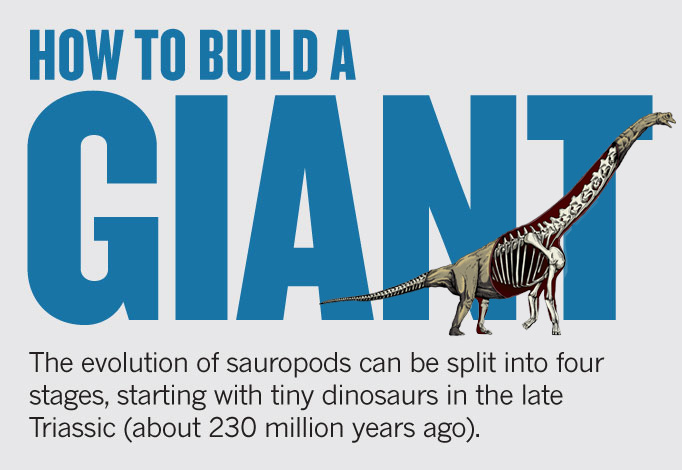
(credit: Nature Publishing Group)


“The First Sea Monster”
- 7 January 2013
After 90 percent of ocean life was wiped out during the great Permian-Triassic extinction, its ecosystems took less time than scientists thought to become as complex as today’s marine food chain—including top-tier giant predators. An international team of paleontologists reveals their discovery in Nevada of "the first sea monster," a four-footed-reptile-turned ocean predator that would have measured nearly 30 feet long. Based on the massive skull containing cutting teeth characteristic of giant predators , the scientists say this ichthyosaur was unlike other ichthyosaurs, whose diets consisted mostly of fish and clams. This one would have fed on larger prey, including other ichthyosaurs.
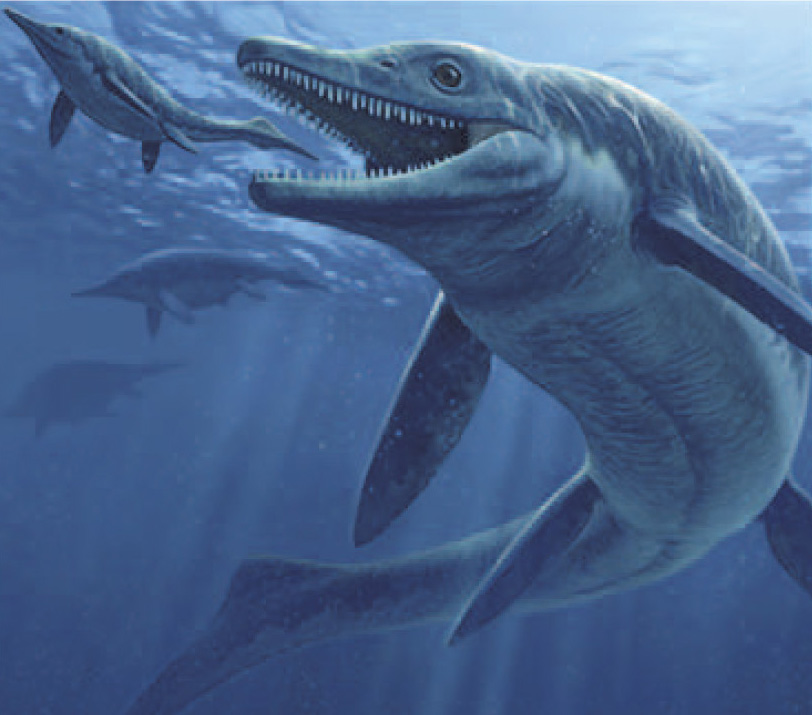
(credit: Raul Martin/© National Geographic Magazine)
“How Giants Conquered the Earth”
- January 2011
How did animals the size of a goat evolve into the largest creatures on Earth? The discovery of a new dinosaur from Argentina may offer some clues. Leonerasaurus taquetrensis shares many features of both sauropods and prosauropods, and evidence shows that many of the distinctive characteristics of sauropods evolved long before the dinosaurs became gigantic.
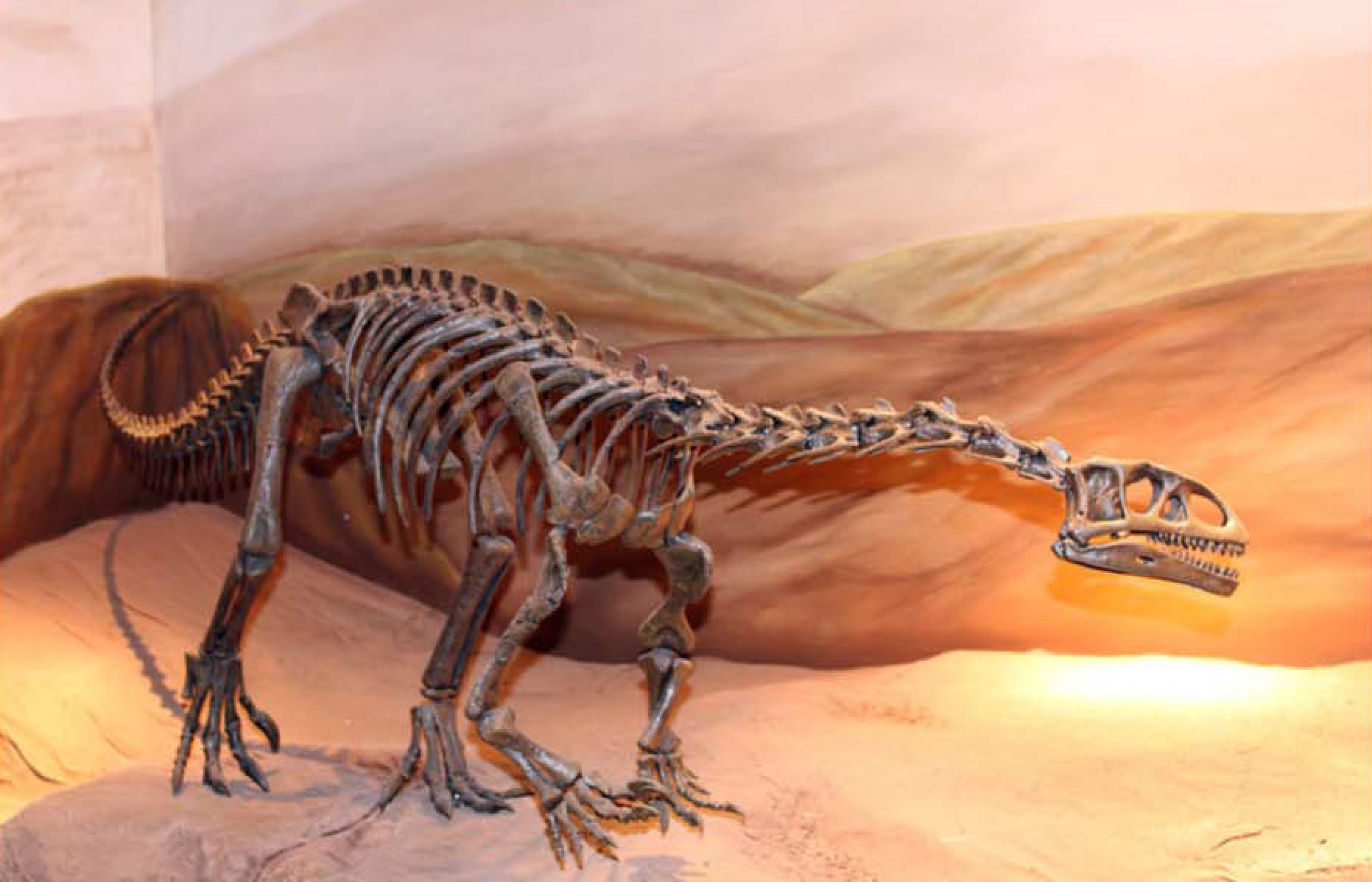
(credit: Diego Pol)

“Rebuilding Greensburg Green”
- February 2009
Everyone assumed this Kansas town was destined to fade away. What would it take to reverse its course? Step one was to level it with a monster tornado. Fred visits the town of Greensburg, Kansas, 2 years after a devastating tornado destroyed 95% of its homes and killed 12 people. This is the story of how these townpeople rebuilt the city of Greensburg — finally living up to its name.

(photo by Frederic Heeren)

“Finding Fossils Faster”
Good-bye, field seasons? A push to year-round collecting
- May 2008; Pages 28-30
East Turkana, Kenya — What unnerves Louise Leakey is not so much the banditry on the only supply road or the gun battles between herders who sometimes mistake researchers for their enemies — it’s the goats. When a fossil in the Lake Turkana region in northern Kenya makes its way back to the eroding surface after several million years, it’s just a matter of time before, as Leakey puts it, “a herd of 200 to 600 goats with those little hooves, four apiece, goes straight over it.” To lose this race against time is to lose specimens forever — including remains of our ancestors.
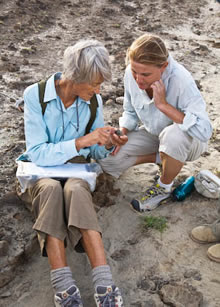
(photo by Peter Lourie)
“Making the Sale”
Give 'em the easy choice
- November 9, 2006
In this modern parable for Nature's "Futures" page, Heeren tells the story of a future when everyone owns a PAD, a Personal Advice Device. This smart, well-proven program provides the best options, displayed on our retinas, as we navigate through life's decisions. But a problem develops for creationists when their young people start using it to evaluate claims from their preachers, such as "There is no evidence that primitive hominids ever existed." Young people equipped with PADs find themselves looking at a sequence of hominid skulls with increasing cranial capacities over time. Those denominations whose leaders most insistently dismiss evolution have the most 'splaining to do - until someone comes up with a PAD that thinks like we do: it rationalizes away anything its owner dislikes.

“Cave Diving for Europe's Past”
Interview with Romanian explorer Stefan Milota
- June 3, 2006
Four years ago, Romanian explorer Stefan Milota made an amazing discovery in previously unknown caves deep within his country's Carpathian mountains: a jawbone that turned out to be the oldest modern human fossil found in Europe. More surprisingly, this mandible showed features that suggested early modern humans might have interbred with Neanderthals. With his climbing buddies at the explorers' club Pro Acva Grup, Milota helped scientists make the subterranean trek to Pestera cu Oase (Cave with Bones) for three seasons of dark, 10-hour days, much of them spent climbing, swimming or diving through tight passages. Fredric Heeren followed the cave divers through the underwater passages on one such trip to ask Milota how he found the 35,000-year-old human remains - an hour's journey deep within a Carpathian mountain.
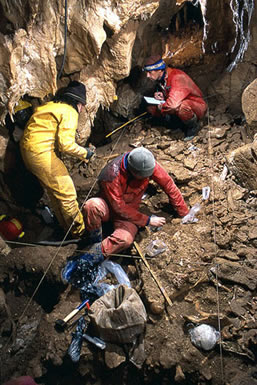
(photo by Mircea Gherase)

“Caveful of Clues About Early Humans”
Interbreeding With Neanderthals Among Theories Being Explored
- September 20, 2004; Page A06
An expedition to the world's most inaccessible human fossil site has wrapped up in the foothills of Romania's Carpathian Mountains. From data gained, scientists hope to wrap up their case for answers to some of the most hotly debated questions about early humans: Did early modern humans make love or war with Neanderthals? Were Neanderthals intellectually inferior to us? A seven-member team hazards daily treks through underwater caves to conclude: Yes, early modern humans interbred with Neandertals 35,000 years ago. And no, Neandertals were not inferior. Other anthropologists examine the fossils and heartily disagree with both conclusions.

“Challenging Fossil of a Little Fish”
- May 30, 2000
The Boston Globe follows Chinese paleontologist Jun-Yuan Chen and his colleagues as they discover and describe fossils of the earliest chordate, the phylum named for the "notochord" that would eventually form the vertebrate backbone. Globe correspondent Fred Heeren reports on their announcement of the 530-million-year-old proto-fish, dubbed Haikouella, at an international science symposium in Chengjiang, China. For Western paleontologists, Haikouella looks like a breakthrough for understanding the origin of the human lineage. "It proves that the direct ancestor of mankind already existed in the time of the Cambrian explosion," says German paleontologist Michael Steiner. Scripps biologist Nicholas Holland reports: "It's the earliest known chordate ancestor. This is going to be page one, two, three and four of vertebrate texts."

“Nothing to fear from NASA”
- June 28, 2001
Fred Heeren reports on NASA's launch of a small spacecraft called the Microwave Anisotropy Probe. MAP will be on a two-year mission orbiting the Sun beyond the Earth's orbit to measure tiny ripples, called anisotropy, in cosmic radiation left over from the Big Bang. Cosmologists hope to distinguish between competing theories to help them learn what caused the universe to start to expand. The 1990 Cosmic Background Explorer (COBE) mission showed what the universe looked like when it was 300,000 years old. MAP should be able to detect gravitational waves, and these could take us back to the tiniest fraction of a second after time began. MIT's Alan Guth, the father of inflation theory, tells Heeren: "Inflation itself takes a very small universe and produces from it a very big universe. But inflation by itself does not explain where that very small universe came from."


“Paleontologic Agitprop?”
- July 24, 2000
Fred Heeren reports on a gathering in China of sixty scientists from around the world; they delivered papers dealing with the theme of the week-long conference: "The Origins of Animal Body Plans and the Fossil Record." Central questions revolved around why so many new phyla evolved in the early Cambrian period, 543 to 535 million years ago. Biologists and paleontologists staked out positions repudiating or supporting Stephen Jay Gould and Niles Eldredge's theory of punctuated equilibrium, in which life evolves in creative bursts followed by long periods of stasis, rather than according to Darwin's (and neo-Darwinism's) gradualism. Disagreements erupted over fundamentally different approaches by Chinese and Western scientists on these issues. But China's Chengjiang locale is where Westerners must now go to learn about the Cambrian period's clearest and earliest remains.

“Was the first craniate on the road to cognition?”
Evolution and Cognition 2003; 9(2): 142-156.
Chinese fossil discoveries of the earliest known craniates (from the early Cambrian period) have led scientists to question whether the evolution of human-level cognition is a rare occurrence in the universe. The earliest chordate is now best represented by a well-documented metazoan called Haikouella lanceolata. Possessing a relatively large brain, this animal appears to demonstrate that the brain and endoskeleton did not evolve together, as had been assumed, but rather that the brain appeared long before full endoskeletization. The paleontologist who describes the animal further notes a "top-down" pattern in the appearances of new forms in the fossil record. Researchers find such observations relevant to the question: Was the evolution of human-level cognition in some sense inevitable, or was it an accident dependent upon historical contingencies? The new evidence for early craniates lends support to the view that human-level cognition may be part of a developmental package, but historical contingencies pose serious problems for a strictly law-like explanation.

“Home Alone in the Universe?”
- March 2002
Pleading ignorance but desiring knowledge, all of us can remain open to the possibility of aloneness as well as alien company. Either way, the truth must surely be a wondrous thing. With options fully open, then - in the true scientific spirit of letting the evidence lead us rather than our presuppositions - we may choose to fully support SETI's quest.
But given what we can know for now, we have little reason to hope for answers from E.T. in our lifetime. We'll have to solve our own problems with war, crime and poverty, make up our own minds about the purpose of life, and seek another "conduit to the ultimate."
Webmaster: Synergy Communications, markpink@comcast.net